
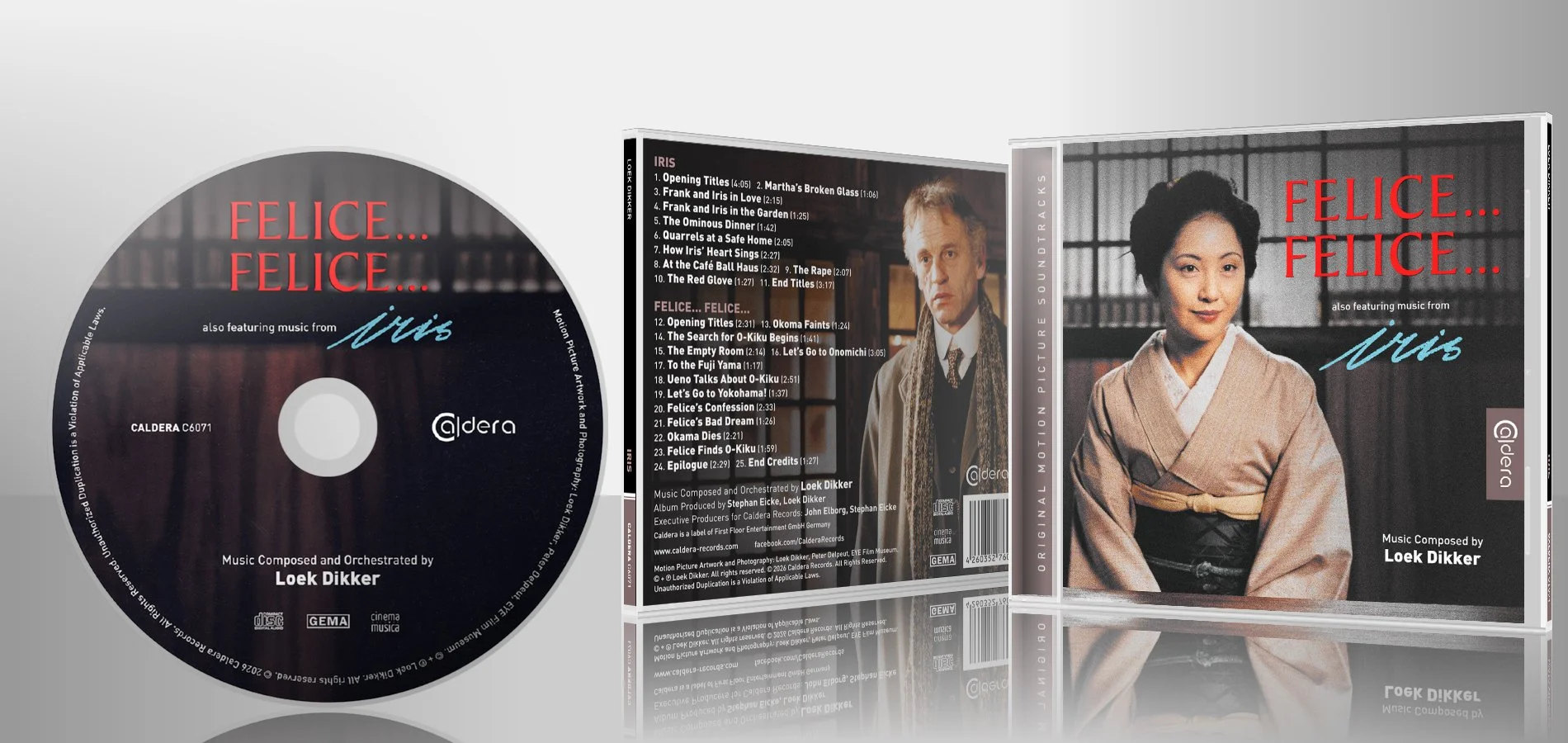
Felice… Felice…/
Iris
Loek Dikker
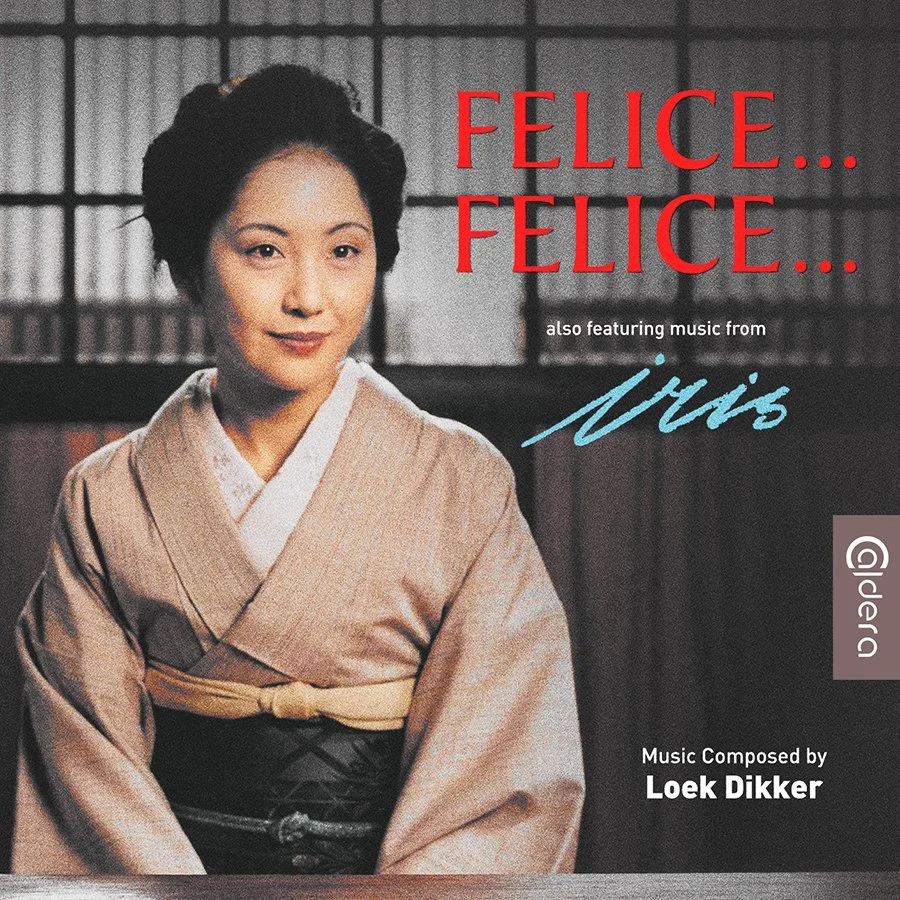
Caldera Records proudly presents Loek Dikker’s scores for the films “Iris” from 1987 and “Felice… Felice…” from 1998.
Both films featured here revolve around an individual entering foreign territory. For Iris, the veterinarian who gives the first film featured here its title, this foreignness is largely figurative. For years, the thirty-year-old has lived with her older husband, an architect, in a big city. Tensions have started to simmer. One day, she leaves her husband to move to an unfamiliar village to begin again. But she soon finds that the local population resents her as a foreigner. It comes as it must: an implosion upends her life.
Loek Dikker’s score for “Iris” proved central to the film’s impact. The composer had started writing for film only a few years before. The buoyant main title – modeled on a Latin American bolero – initially suggests lightness. For Dikker, it expressed Iris’s vitality. As hostility mounts, the music darkens. It reflects the unease of her rural surroundings. In the finale, acceptance brings the bolero back. It completes the arc.
Peter Delpeut’s film “Felice… Felice…”, loosely inspired by Felice Beato, explores the tension between illusion and truth. They are forces locked together, each straining for dominance like two bulls in an arena.
In 1895 (the year of the first film screening), photographer Beato returns to Japan after some time away. Once a pioneering photojournalist who captured raw life in Asia, he has abandoned photography. Johan Leysen plays him with sorrowful gravitas: a man hollowed by loss, still mourning his wife, O-Kiku, whom he met in the when he first set foot in Japan.
Director Peter Delpeut’s gentle, wise and moving meditation on the nature of memory explores a changing Japan, cultural differences, and our fear of forgetting and of being forgotten. It demanded a delicate score. Composer Loek Dikker had the difficult task of developing music that captures Beato’s restlessness, his hope and desire, while at the same time providing the appropriate musical accompaniment for the photographs of a lost place. Loek Dikker sought a balance between the East and the West. He wanted his music to flow almost imperceptibly, as he elaborates: “Many scenes are fragile like thin glass. This was an extra complication for me.”
The 71st CD-release of Caldera Records features a detailed booklet text by Stephan Eicke and elegant artwork by Luis Miguel Rojas. The CD was mastered by Richard Moore and produced by Stephan Eicke and Loek Dikker.
C6071
Music Composed and Orchestrated by Loek Dikker
Album Produced by Stephan Eicke, Loek Dikker
Executive Producers for Caldera Records: John Elborg, Stephan Eicke
Album Art Direction and Design by Luis Miguel Rojas
Listen to the sound clips by clicking on the links below
Iris
1. Opening Titles (4:05)
2. Martha’s Broken Glass (1:06)
3. Frank and Iris in Love (2:15)
4. Frank and Iris in the Garden (1:25)
5. The Ominous Dinner (1:42)
6. Quarrels at a Safe Home (2:05)
7. How Iris’ Heart Sings (2:27)
8. At the Café Ball Haus (2:32)
9. The Rape (2:07)
10. The Red Glove (1:27)
11. End Titles (3:17)
Felice… Felice…
12. Opening Titles (2:31)
13. Okoma Faints (1:24)
14. The Search for O-Kiku Begins (1:41)
15. The Empty Room (2:14)
16. Let’s Go to Onomichi (3:05)
17. To the Fuji Yama (1:17)
18. Ueno Talks About O-Kiku (2:51)
19. Let’s Go to Yokohama! (1:37)
20. Felice’s Confession (2:33)
21. Felice’s Bad Dream (1:26)
22. Okama Dies (2:21)
23. Felice Finds O-Kiku (1:59)
24. Epilogue (2:29)
25. End Credits (1:27)